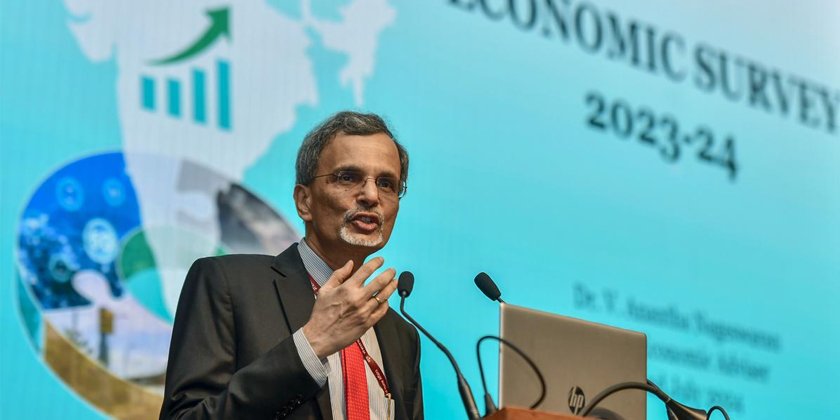
As India stands on the threshold of a new fiscal year, the Economic Survey 2023-2024 provides a comprehensive overview of the country’s economic performance, challenges, and prospects. This document, traditionally released a day before the Union Budget, sets the stage for the government’s fiscal policies and strategic initiatives for the upcoming year.
The Economic Survey 2023-2024 presents a mixed picture of India’s economic landscape. Despite global uncertainties, supply chain disruptions, and domestic challenges, the Indian economy exhibited resilience. According to the Survey, The real GDP in FY24 was 20% higher than its level in FY20 – a feat that only a very few major economies achieved, while also leaving a strong possibility for robust growth in FY25 and beyond.

The manufacturing sector, bolstered by the Production Linked Incentive (PLI) scheme, recorded a growth of 7.2%, while the services sector continued to be a major contributor, growing at 8.1%. The survey also highlights the positive impact of digitalization and technological advancements across various sectors, enhancing productivity and efficiency.
Infrastructure development was a cornerstone of economic policy, with the National Infrastructure Pipeline (NIP) driving investments in critical sectors such as transportation, energy, and urban development. The survey notes substantial progress in the execution of key infrastructure projects, including highways, railways, and renewable energy installations.
The Survey paints a promising yet challenging picture of India’s supply chain and logistics industry. The survey underscores significant strides made in infrastructure development, policy implementations, and technological integration. With the Union Budget 2024-25 now in the picture, the synergy between these efforts and future fiscal policies will be pivotal in transforming India’s logistics landscape into a global benchmark.

PM GatiShakti National Master Plan (PMGS-NMP)
The PM GatiShakti National Master Plan (PMGS-NMP) is central to the government’s strategy to enhance multimodal infrastructure planning. This initiative, involving 43 ministries, aims to bridge last-mile connectivity gaps, ensuring seamless movement of goods and people.
By March 2024, 1,530 data layers, encompassing both ministry and state data, were integrated into the PMGS-NMP portal. This comprehensive approach is expected to streamline project planning and execution, with 533 projects already under evaluation, worth an estimated ₹13.3 lakh crore.
By March 2024, 1,530 data layers, encompassing both ministry and state data, were integrated into the PMGS-NMP portal. This integration facilitates coordinated and efficient project planning, reducing redundancies and optimizing resource allocation. The master plan includes a detailed mapping of existing and proposed infrastructure across sectors like railways, highways, ports, and airports, creating a holistic view of the nation’s logistics network.
The PMGS-NMP‘s comprehensive approach has already yielded results, with 533 projects under evaluation, amounting to an estimated INR 13.3 lakh crore. These projects are expected to significantly enhance India’s logistical capabilities, reducing transportation costs and time, and ultimately making Indian goods more competitive globally.
National Logistics Policy (NLP)
Launched in September 2022, the National Logistics Policy (NLP) complements the PMGS-NMP by aiming to create an integrated, efficient, and cost-effective logistics network. The NLP’s primary objectives include reducing logistics costs, improving India’s Logistics Performance Index (LPI) ranking, and fostering a data-driven decision-support system.
One of the key initiatives under the NLP is the Unified Logistics Integrated Platform (ULIP). This platform integrates real-time information from multiple sources, offering visibility into logistics operations across the country. With 1,800 data fields spanning various ministries, ULIP enables better coordination and informed decision-making, reducing bottlenecks and improving efficiency.
Additionally, the Logistics Data Bank (LDB) plays a crucial role in tracking containerized export-import (EXIM) cargo. Utilizing RFID, IoT, and Big Data analytics, the LDB provides end-to-end visibility of cargo movement, helping stakeholders anticipate delays and streamline operations. The NLP also emphasizes capacity building, with training programs designed to enhance the skills of logistics professionals.
World Bank’s Logistics Performance Index
India’s logistics sector has witnessed substantial improvements, reflected in its rise from 44th place in 2018 to 38th in 2023 in the World Bank’s LPI. This progress is largely attributed to policy reforms, digitalization, and infrastructure upgrades.
The implementation of the Goods and Services Tax (GST) has been a game-changer, significantly reducing logistics costs. By eliminating state-level taxes and streamlining interstate trade, the GST has improved the efficiency of logistics operations. According to the Economic Survey, travel time for trucks has decreased by up to 30%, and the average distance covered by trucks has increased from 225 km pre-GST to 300-325 km.
Digital initiatives, such as the e-way bill system, have further streamlined logistics operations. The e-way bill facilitates the seamless movement of goods by providing a unified online system for tracking consignments, reducing paperwork and compliance burdens(Economic Survey Complet…).
State-Level Engagement and Capacity Building
State governments play a crucial role in the logistics ecosystem. Recognizing this, the central government has encouraged states to align their logistics policies with the NLP. As of now, 26 states have notified their logistics policies, demonstrating a collective commitment to improving the logistics infrastructure and operations across the country.
The Logistics Ease Across Different States (LEADS) survey has been instrumental in assessing and enhancing state-level logistics performance. By providing a benchmark for states to aspire to, the LEADS survey fosters a competitive environment, encouraging states to innovate and implement best practices.
Capacity-building initiatives are also a key focus area. The Economic Survey highlights several training programs aimed at enhancing the skills and knowledge of logistics professionals. These programs, integrated with central and state training institutes, ensure a consistent and high standard of training across the country.
Infrastructure Development and Investments
Infrastructure development remains a cornerstone of India’s logistics strategy. The government’s emphasis on road, rail, air, and digital connectivity has resulted in significant growth in assets across these sectors.
The Economic Survey details substantial investments in logistics infrastructure, with public sector funding playing a dominant role. From 2019 to 2023, the central and state governments contributed 49% and 29% of total investments, respectively. The private sector’s contribution, while significant at 22%, underscores the need for increased private investment to sustain and accelerate infrastructure growth.
Key projects under the PMGS-NMP include the expansion of highways, modernization of railway networks, development of dedicated freight corridors, setting up multimodal logistics parks, and upgrades to port and airport facilities. These projects are expected to enhance multimodal connectivity, reducing transportation costs and time, and improving the overall efficiency of the logistics network.
Union Budget 2024-25: Expectations and Implications
Following Prime Minister Narendra Modi’s historic re-election for a third term, Finance Minister Nirmala Sitharaman presented the Union Budget 2024-25 this week. The budget underscores the government’s commitment to addressing key national priorities, with a strong focus on employment, skilling, MSMEs, and the middle class. In line with the budget announcements during the last five years, the Government of India has kept a special focus on the logistics and supply chain industry, ensuring appropriate financial support. Key areas of focus include:
- Increased Funding for Infrastructure Projects: Enhanced budget allocations for ongoing and new infrastructure projects will be crucial to maintaining the momentum in connectivity improvements.
- Policy Reforms and Incentives: Further policy reforms and incentives to attract private investments in logistics infrastructure and technology adoption will be essential for sustainable growth.
- Technological Integration: Continued emphasis on integrating advanced technologies such as AI, IoT, and Big Data into logistics operations to enhance efficiency and reduce costs.
- Environmental Sustainability: Investment in green logistics solutions, including electric vehicles and renewable energy sources, to reduce the carbon footprint of the logistics industry.
Conclusion
The Economic Survey 2023-2024 sets a hopeful yet cautious tone, acknowledging the achievements while highlighting the challenges ahead – turning out to be a perfect budgetary prelude. The Union Budget 2024-25, building on the survey’s insights, has introduced strategic measures aimed at fostering economic growth, ensuring fiscal stability, and enhancing social welfare. As India navigates the complexities of a dynamic global environment, the budget will serve as a blueprint for sustainable and inclusive development, steering the nation towards a prosperous future.