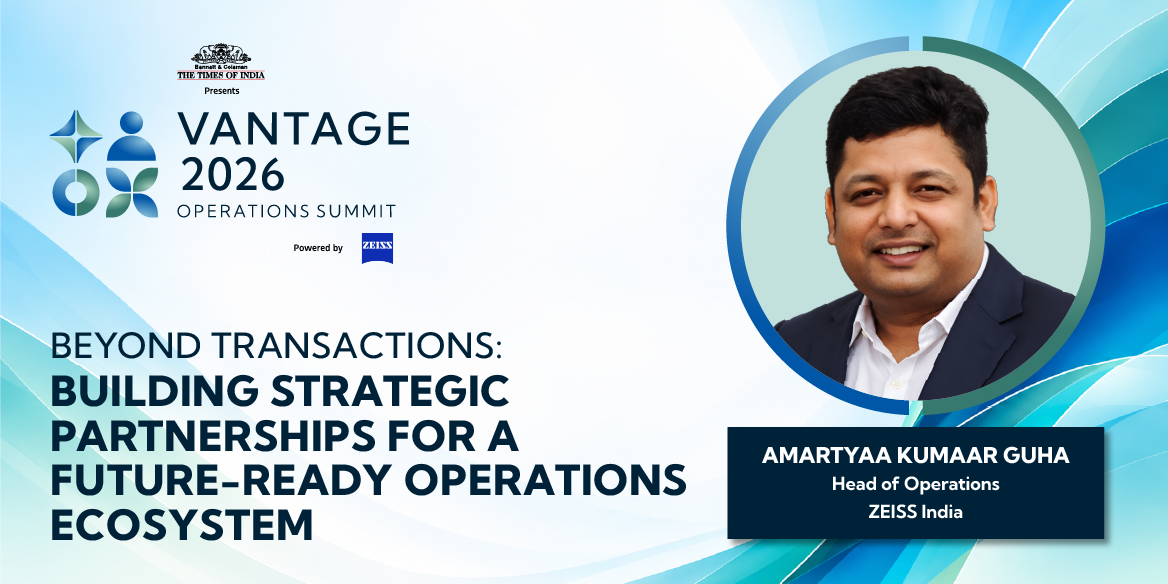
As business operations become increasingly complex and technology driven, the strength of an organisation’s supplier ecosystem is emerging as a critical competitive advantage. Moving beyond conventional buyer-supplier relationships, the focus is shifting towards collaboration, innovation and shared value creation. For ZEISS India, this philosophy is central to its approach to building a resilient, agile and future-ready operational ecosystem. In this conversation ahead of VANTAGE 2026, the organisation’s inaugural flagship supplier event, Amartyaa Kumaar Guha, Head of Operations at ZEISS India, discusses the evolving role of suppliers, the growing contribution of MSMEs and startups, and the importance of digitalisation, automation and responsible sourcing. He also explores how VANTAGE aims to bring industry stakeholders together to shape the next chapter of India’s industrial growth.
What is your role at ZEISS India?

As Head of Operations at ZEISS India SSC, I run operations as a strategic enabler of business growth. I lead the end-to-end Supply Chain function, covering warehousing, logistics and planning, along with indirect procurement across roughly 25 categories in India. Our new Control Tower brings visibility and data-driven decision-making, while a dedicated Process Excellence team drives efficiency, innovation and digitalisation. I also oversee Facilities and Administration across all our locations in India and lead CSR initiatives that create meaningful social impact. My goal is a robust, agile and scalable operational ecosystem that supports today’s business and enables tomorrow’s growth.
VANTAGE is the inaugural flagship supplier event being hosted this December. What was the primary catalyst for convening over 400 suppliers, MSMEs, startups and leaders under one roof, and how does this fit into its broader growth trajectory?
VANTAGE grew out of a simple belief: no industry becomes competitive on the strength of a few large players alone. India’s industrial ecosystem is built by its suppliers, MSMEs and startups as much as by the companies that buy from them, and it deserves a platform where all of them meet as equals. Bringing more than 400 suppliers, MSMEs, startups and leaders together lets us strengthen that ecosystem, encourage innovation, develop future talent and build stronger relationships across the value chain. It also supports global growth ambitions, because competitive global businesses depend on a sustainable, capable local industrial base, one where suppliers are strategic partners in future growth, not merely vendors.

Traditional buyer-supplier dynamics are shifting from transactional relationships to strategic value co-creation. How is the organisation redefining its relationship with its supplier and vendor ecosystem in India?
Our industry is moving from transactional buying and selling to strategic value co-creation. The shift is about building an integrated ecosystem of collaboration, innovation, knowledge-sharing and recognition. That means sharing future requirements openly, learning from the ideas partners bring, and recognising the contribution they make. When buyers and suppliers grow together, the whole industry becomes stronger, and VANTAGE is one way we are putting that principle into practice.
Precision and quality are core to the organisation’s ethos. In today’s complex supply chain environment, how is the organisation working with partners to maintain uncompromised standards while driving operational efficiency?
Precision and quality are the foundation of industrial credibility, and no single organisation can deliver them alone. The way forward is shared standards: clear, standardised processes, transparency and continuous improvement across the value chain. Digital integration, analytics and control-tower visibility help partners spot issues early and decide faster, so quality and efficiency reinforce each other rather than compete. As an industry, we should treat uncompromised standards as the entry point for growth, not a cost to be traded off.
VANTAGE 2026 will potentially feature dedicated spaces like the Pitch Zone to engage MSMEs and startups. What unique capabilities or agility do young companies bring to the supply chain, and how do you support their integration?
Startups and MSMEs bring agility, fresh thinking and a willingness to try new approaches, and many offer capabilities that complement those of established suppliers. Platforms such as the Pitch Zone at VANTAGE give them a direct route to showcase what they can do. The industry’s role is to understand their strengths, share future requirements and open the door to collaboration. Every organisation, irrespective of its size, has something valuable to contribute, and the ecosystem is stronger when large and small players grow together.
Automation and digital tools are transforming manufacturing and logistics. Over the next 3–5 years, what key technological or digital shifts do you expect your supply chain partners to adopt?
Over the next 3–5 years, I expect industry-wide adoption of AI, automation and advanced analytics to reduce manual effort and man-hours while delivering faster, more accurate results. In areas such as Order-to-Cash, intelligent automation will minimise manual data entry and streamline processes. Advanced analytics will play a key role in capacity planning, product planning and overall productivity. There are also opportunities in smarter space management and digital support systems for employees, u l t ima te l y enhanc i ng customer service. Stronger analytics within control towers will enable better visibility, planning and faster decisionmaking. With extensive global supplier networks, cleaner, standardised processes and seamless digital integration will be essential. Ultimately, the goal is a more connected, efficient and data-driven supply chain ecosystem that drives productivity and improves service delivery.
Given recent global disruptions, resilience and ESG/sustainability have become top priorities. How is the organisation aligning its sustainability goals with its supplier network to ensure responsible sourcing and risk mitigation?
Building a resilient supplier ecosystem goes hand in hand with responsible and sustainable business practices. Industry leaders need to focus on long-term partnerships, supply chain transparency and working closely with suppliers to identify and mitigate risks early. Responsible sourcing, compliance, resource efficiency and continuous improvement should be integral to every buyer-supplier relationship. Resilience cannot be built by one organisation alone; it requires collaboration, visibility and shared responsibility across the entire supplier network.
As we approach VANTAGE 2026, to be held in Mumbai, what message or call to action would you like to leave with the logistics, suppliers and manufacturing leaders preparing to attend?
My message to the industry is simple: let us move beyond transactional relationships and build partnerships that create longterm value. VANTAGE is not just a platform for buyers and suppliers to connect; it is an opportunity to exchange ideas, showcase innovation, understand future requirements and explore new possibilities for collaboration. I encourage suppliers, MSMEs, startups and industry leaders to participate actively, share their capabilities and bring forward fresh ideas. Every organisation, irrespective of its size, has something valuable to contribute. If we collaborate, innovate and grow together, we can build a stronger, more agile and future-ready industrial ecosystem for India.