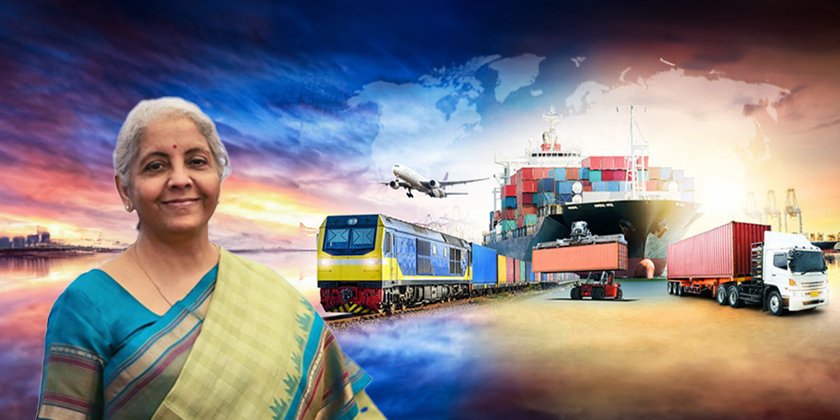
Following Prime Minister Narendra Modi’s historic re-election for a third term, Finance Minister Nirmala Sitharaman presented the Union Budget 2024 in today’s parliamentary session. The budget underscores the government’s commitment to addressing key national priorities, with a strong focus on employment, skilling, MSMEs, and the middle class. In line with the budget announcements during the last five years, the Government of India has kept a special focus on the logistics and supply chain industry, ensuring appropriate financial support. Here’s what the Union Budget 2024 allocates for the supply chain and logistics industry’s development.
Skilling and Workforce:
The Union Budget 2024 outlines an ambitious plan to generate 4.1 crore jobs over the next five years, supported by a ₹2 lakh crore allocation. Central to this effort is a dedicated ₹1.48 crore fund aimed at skilling 20 lakh youth. The initiative includes upgrading 1,000 industrial training institutes to align courses with industry needs, a one-time wage subsidy for first-time employees via Direct Benefit Transfer (DBT), and offering internships in 500 companies to one crore youth. Additionally, the budget plans to establish working women hostels and creches, enhancing economic inclusivity, with over ₹3 lakh crore allocated for women and girls.

Infrastructure:
The central government has allocated ₹11.11 lakh crore for capital expenditure, emphasizing its commitment to infrastructure development and its potential economic impact. State governments have been encouraged to match this investment, while private sector involvement will be supported through viability gap funding and favorable policies.
The National Industrial Corridor Development Programme will see the development of 12 new industrial parks with comprehensive infrastructure and ‘plug and play’ facilities, strategically located in or near 100 cities.
Bihar will receive a substantial ₹26,000 crore for major infrastructure projects, including highways, a new power plant, and developments in airports, medical colleges, and sports infrastructure. Investments in the Visakhapatnam-Chennai Industrial Corridor (VCIC) will strengthen economic ties with Southeast Asia and East Asia, alongside the development of other industrial corridors.

MSMEs:
A new credit guarantee scheme will support MSMEs by facilitating term loans without collateral or third-party guarantees. This scheme includes a self-financing guarantee fund providing coverage up to ₹100 crore per applicant.
Other measures include lowering the turnover threshold for TReDS platform onboarding, establishing 24 new SIDBI branches, increasing the Mudra loan limit to ₹20 lakh, and setting up e-commerce export hubs for international market access. A new mechanism will also facilitate continued bank credit to MSMEs during stress periods, helping them avoid becoming non-performing assets (NPAs).
Aviation and Shipping:
To support the domestic aviation and boat and ship MRO (Maintenance, Repair, and Overhaul) industries, the budget extends the export period for goods imported for repairs from six months to one year and increases the re-import time limit for goods under warranty from 3 to 5 years. The government aims to enhance MRO activities, previously reliant on international facilities, by applying a uniform 5% IGST rate to aircraft and engine parts.
Reforms in ownership, leasing, and flagging are set to boost the Indian shipping industry’s share and create additional employment opportunities.
Enhancing Ease of Doing Business:
The budget also advances Jan Vishwas Bill 2.0 and incentivizes states to implement business reform action plans and digitalization, aiming to further improve the business environment.
This budget reflects a comprehensive strategy to drive economic growth, enhance workforce participation, and support critical industries, setting the stage for a transformative year ahead.