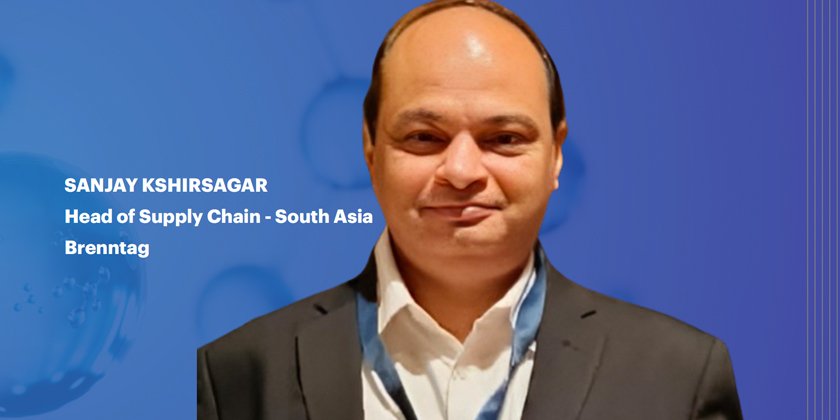
Brenntag’s role as the global leader in chemicals and ingredient distribution is underpinned by a robust supply chain strategy. With a presence in nearly 600 sites across 72 countries, Brenntag seamlessly integrates global reach with local expertise to meet diverse regional demands effectively. In this interview with Sanjay Kshirsagar (Head of Supply Chain – South Asia at Brenntag), we explore how Brenntag navigates the complexities of the global chemical supply chain, addresses key challenges facing the industry, and anticipates future trends.
Brenntag is recognized as the global market leader in chemicals and ingredient distribution. How have its supply chain operations contributed to this status?

Brenntag’s status as a global market leader can be attributed to several key aspects of its supply chain operations. The organization prioritizes logistical safety and efficiency, handling, storing, and transporting chemicals with strict safety measures to build trust among customers and suppliers. With nearly 600 sites across 72 countries, Brenntag leverages a global network while applying local expertise to meet regional demands effectively.
Modern warehouses, blending facilities, and reliable transportation infrastructure enable Brenntag to deliver chemicals swiftly and reliably, crucial in a market where supply chain efficiency directly impacts production.
Brenntag’s commitment to sustainability includes optimizing transportation routes, investing in renewable energy, and promoting sustainable products, aligning with global trends and client preferences.

Long-term strategic partnerships with major suppliers and customers enhance supply chain stability and foster collaborative innovation. A customer-centric approach ensures Brenntag understands and meets diverse customer needs, offering customized solutions, technical support, and value-added services beyond distribution.
Embracing supply chain innovation and continuous improvement, Brenntag stays ahead of industry changes and maintains competitiveness through ongoing process evaluation and enhancement.
These operational strengths have solidified Brenntag’s position as the global leader in chemicals and ingredient distribution, underscoring its excellence in logistics, infrastructure, sustainability, partnerships, customer-centricity, and innovation.
What are the biggest challenges facing your industry segment in present times?
The chemical distribution industry currently grapples with several significant challenges that impact operations and strategic planning.
Chief among these challenges is the disruption within global supply chains, exacerbated by geopolitical tensions, natural disasters, and the lingering effects of pandemics like COVID-19. These disruptions often result in delays, increased costs, and shortages of essential chemical supplies.
Another critical issue facing the industry is regulatory compliance. With stringent regulations governing safety, environmental impact, and chemical handling varying across regions, companies must navigate complex compliance landscapes that can incur substantial costs and operational complexities.
Moreover, there is mounting pressure on the industry to address sustainability and environmental concerns. Stakeholders increasingly demand sustainable practices, urging companies to manage waste effectively, reduce carbon emissions, and adopt green chemistry initiatives throughout production and distribution processes.
The advent of digital transformation presents both opportunities and challenges. While digital technologies promise efficiency gains and improved decision-making capabilities, their implementation requires significant investment in infrastructure and workforce training. Integrating these technologies seamlessly into existing processes remains a formidable task.
Economic volatility further compounds these challenges, with fluctuations in raw material prices, currency exchange rates, and inflation impacting profit margins and operational costs unpredictably. Meeting evolving customer expectations for higher quality, faster delivery, and personalized services while maintaining cost efficiency adds another layer of complexity.
A critical concern is the industry’s workforce skills gap. Attracting and retaining skilled professionals, especially in technical and specialized roles, is essential for innovation and operational excellence. Continuous training and development programs are crucial to keeping pace with advancements in the field.
Additionally, geopolitical risks such as political instability and trade disputes pose threats to market access and business continuity on a global scale. Navigating these risks requires companies to adopt a proactive approach, strategic planning, and agility in responding to changing international dynamics.
This is the abridged version of Sanjay Kshirsagar’s interview published in the September 2024 issue of Logistics Insider magazine. To read the complete interview, click here.