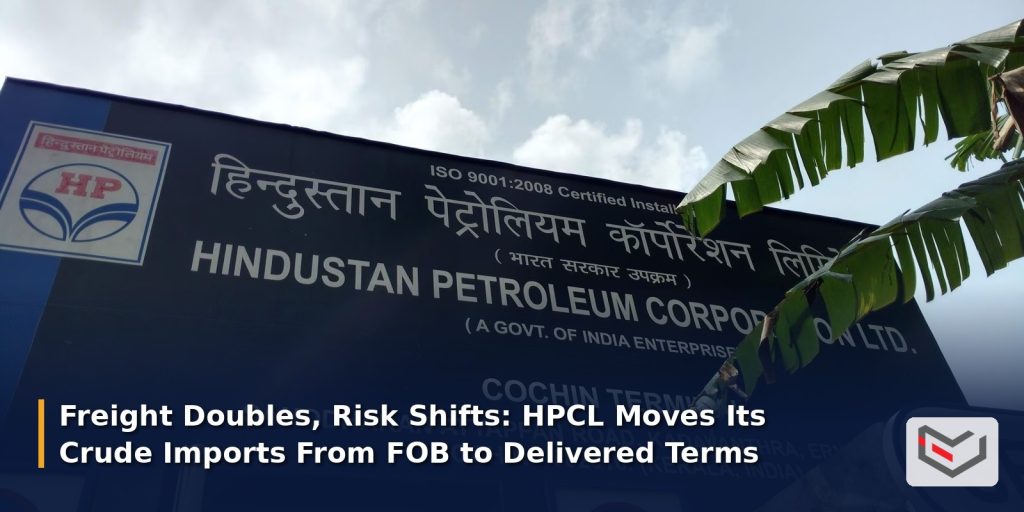
Hindustan Petroleum Corporation Ltd (HPCL) is now buying almost all of its crude on a delivered basis. That hands the job of shipping the oil, and the risk that comes with it, to sellers, as tanker freight climbs and attacks on vessels around the Strait of Hormuz continue.
“For all practical purposes right now almost everything we are looking at is on landed basis except where we think we can send a ship and pick it up cheaper,” chairman and managing director Vikas Kaushal said on 23 October. He was speaking on the state-run refiner’s September-quarter earnings call.

Delivered cargoes used to make up about half of HPCL’s crude imports, he said. The company directly operates three refineries with a combined capacity of 670,000 barrels per day.
From FOB to delivered
Kaushal said HPCL used to buy much of its crude under term contracts and on a free-on-board (FOB) basis. Now, he said, almost everything is bought delivered ex ship (DES).
The difference is who runs the voyage. Under FOB, the seller’s job ends once the crude is loaded at the export terminal. The buyer charters the tanker, pays the freight and insurance, and carries the risk at sea. Under DES, the seller arranges and pays for the ship and bears the risk until the cargo reaches the buyer’s discharge port. The buyer pays a single landed price.

Risk is a big part of HPCL’s reasoning. It is increasingly choosing delivered cargoes to avoid exposing its own vessels to attacks and other risks linked to the regional conflict, now in its eighth month. It is a reminder that West Asian tensions are now as much a logistics problem as an oil supply one for India.
Freight has doubled
Freight rates doubled in the July–September quarter from the previous three months, HPCL’s director (finance), Srividya Venkataraman, told analysts. Shipping crude on a Suezmax tanker now costs about $9 per barrel, up from $3–4 in the June quarter, she said.
Spot rates for oil tankers hit all-time highs in early October, Reuters reported on 20 October, as shuttle services and ship-to-ship transfers out of the Strait of Hormuz tied up vessels in the Gulf.
Why freight discounts matter
Delivered buying works for HPCL because sellers are under pressure too: producers with stranded cargoes are offering discounts to offset higher freight costs.
“The impact on landed prices might not be as much as you guys think from outside because the producers of oil are also stuck,” Kaushal said. He added that returns to producers with stranded cargoes were much lower than publicly reported.
When freight is folded into one landed price, a seller keen to move its oil absorbs part of the voyage cost. Traders told Reuters this month that Abu Dhabi National Oil Co (ADNOC) had sold cargoes loading over the next two months on a delivered basis to China and India, and that Saudi Aramco had sold delivered cargoes to Asian buyers for November. In both cases, the sellers absorbed the shipping costs.
Rajasthan refinery update
Kaushal also said HPCL expects to start producing high-sulphur fuel oil at its 180,000-barrel-per-day Rajasthan refinery in December. The refinery is running at 60% of capacity and should reach full capacity by end-December or early January, he said.
With inputs from Reuters and Moneycontrol