In the early hours of March 16, a drone strike near Dubai International Airport (DXB) triggered a fire in the vicinity of a fuel tank and forced authorities to temporarily suspend flights at one of the world’s most important aviation hubs. The incident caused diversions, halted operations by the airport’s main carrier, and prompted a limited restart later in the day.
For a city that has built its economic identity on seamless global connectivity, the symbolism could not be sharper. The very infrastructure that helped Dubai dominate global air cargo is now being disrupted by the geopolitical forces reshaping the Middle East.

The attack is only the latest shock in a rapidly escalating regional conflict that has seen missiles and drones targeting Gulf infrastructure and widespread airspace closures across the region.
For the global logistics industry, the question is no longer hypothetical: is Dubai’s crown as the world’s pre-eminent transshipment air cargo hub under threat?
A Hub Built on Geography and Precision
For two decades, Dubai perfected a logistics model that reshaped global air cargo flows. Sitting at the midpoint between Asia, Europe, and Africa, the emirate turned geography into strategy.

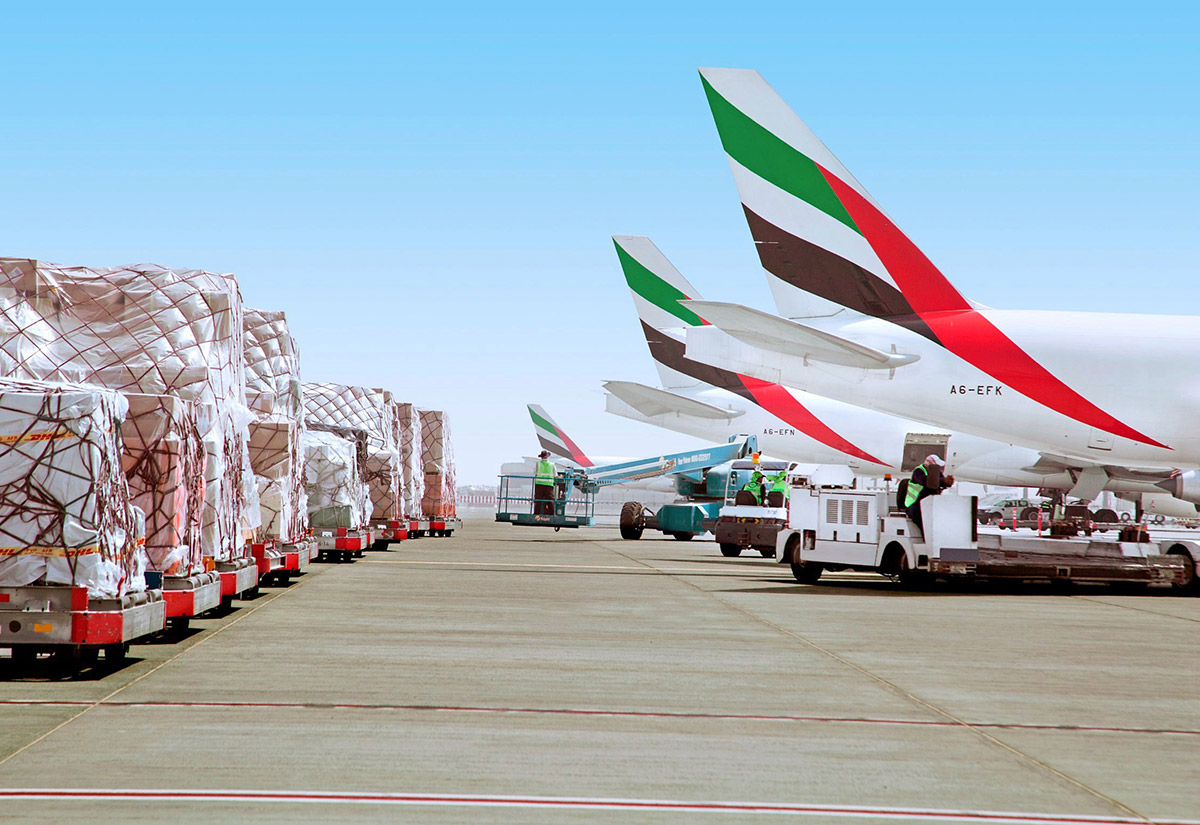
Dubai International Airport and its cargo ecosystem (anchored by Emirates SkyCargo) function as a massive transfer node where shipments arriving from Asia are redistributed to Europe, Africa, and the Americas. The hub-and-spoke system dramatically reduces transit times and enables airlines to consolidate cargo flows efficiently.
A large portion of cargo moving along the critical Asia–Europe corridor relies on Gulf hubs such as Dubai, Doha, and Abu Dhabi as intermediary transfer points.
In normal times, the model works flawlessly. Aircraft arriving from Shanghai, Hong Kong, or Mumbai unload cargo that is quickly transferred onto outbound flights heading to Frankfurt, Amsterdam, Nairobi, or São Paulo.
But the system depends on a single assumption: the hub must remain operational, secure, and predictable. That assumption is now being tested.
Airspace Chaos and Cargo Disruption
Since the conflict escalated in late February, large portions of Middle Eastern airspace have been closed or restricted, forcing airlines to cancel flights, reroute aircraft, or suspend services altogether.
Airlines, including major European and Asian carriers, have halted operations to several Gulf destinations, including Dubai, while cargo carriers have either suspended routes or diverted shipments to alternative gateways.
The consequences for air cargo have been immediate. Flight reroutings are adding hours to journeys between Asia and Europe, increasing fuel consumption and reducing available capacity. As aircraft avoid conflict zones, global air cargo capacity has tightened, pushing freight rates higher and creating operational bottlenecks across supply chains.
In essence, a region that once optimised global connectivity has suddenly become a risk corridor.
When the Hub Itself Becomes the Story
A single drone attack near Dubai International Airport has underscored the vulnerability of logistics infrastructure during geopolitical crises.
Although authorities contained the fire quickly and no injuries were reported, the temporary suspension of flights sent a clear signal across global supply chains.
Dubai’s aviation system is engineered for uninterrupted throughput. Any disruption—whether a runway closure, airspace restriction, or security incident—creates cascading delays across the tightly synchronised network of inbound and outbound cargo flights.
More importantly, the attack highlights a deeper irony: the very success of Dubai’s logistics ecosystem has made it a strategic target.
The emirate’s ports, airports, free zones, and financial infrastructure collectively form one of the most important logistics nodes in the world. Disrupting that node can reverberate across global trade.
Cargo Begins Looking for Alternatives
When a major hub becomes uncertain, cargo flows do not stop; they simply reorganise themselves.
Some airlines are beginning to bypass Gulf hubs entirely, operating longer direct flights between Asia and Europe or shifting cargo through alternative transit points.
Other logistics operators are exploring secondary hubs in regions perceived as safer, including parts of South Asia, the Eastern Mediterranean, and Southeast Asia.
The shift is still temporary. But history shows that logistics networks can evolve quickly once carriers begin redesigning routes.
The Real Risk: Network Redesign
The most significant threat to Dubai’s transshipment dominance is not a single drone strike or temporary closure. It is the possibility that airlines and freight forwarders redesign their networks to avoid the region.
Once new routes, schedules, and consolidation hubs are established, reversing them can be difficult.
The Asia–Europe air cargo corridor is one of the busiest trade lanes in the world. If carriers begin systematically routing cargo through alternative hubs, Dubai’s central role in global aviation logistics could gradually weaken.
However, the emirate still retains enormous structural advantages: world-class infrastructure, one of the largest long-haul airline fleets, and a deeply integrated logistics ecosystem linking air cargo with maritime and land transport. Those advantages cannot be replicated overnight.
A Test of Resilience
Dubai’s rise as a global logistics hub has always been built on its ability to adapt to disruption: from financial crises to pandemics. The current geopolitical crisis represents another test of that resilience.
For now, flights are gradually resuming, cargo operations continue under constraints, and the city’s logistics system remains functional.
But the drone strike near Dubai International Airport has delivered a stark reminder to the industry: even the world’s most sophisticated logistics hubs are not immune to geopolitical turbulence.
And in the high-stakes world of air cargo transshipment, reliability is the real crown jewel.
Whether Dubai retains that crown will depend not just on infrastructure or airline capacity, but on how quickly stability returns to the skies above the Middle East.