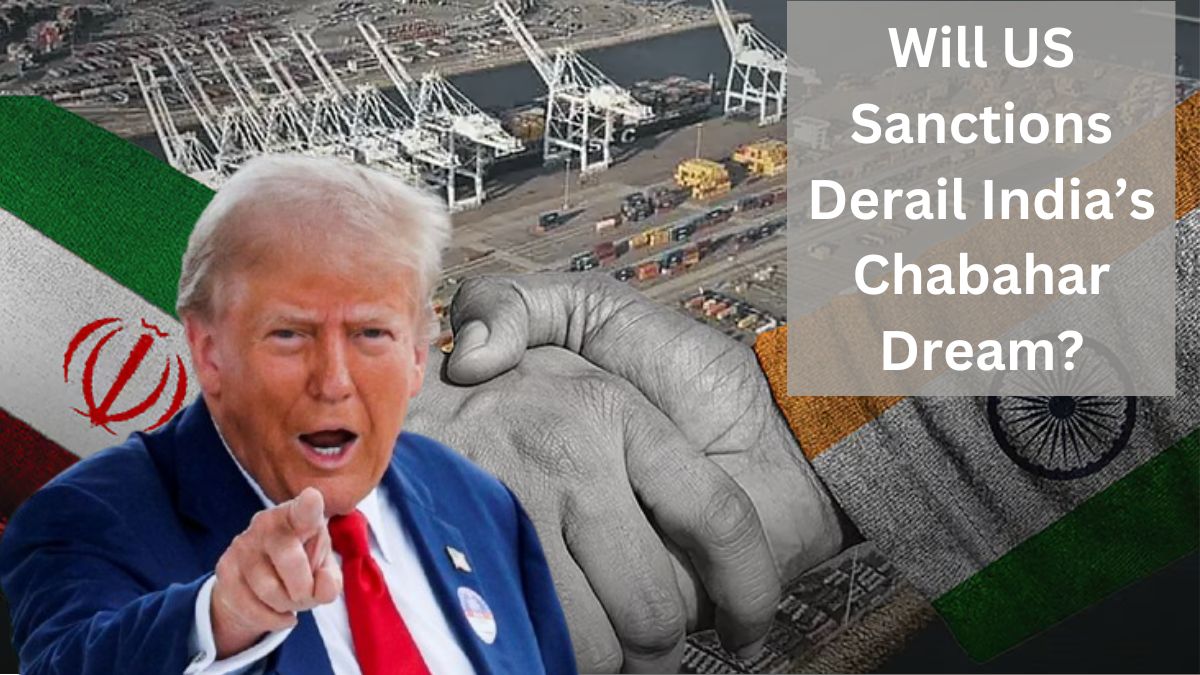
The revival of former US President Donald Trump’s “maximum pressure” campaign on Iran has placed India in a risky position. The latest directive, which includes the removal of waivers on sanctions related to Iran’s Chabahar port, threatens to disrupt India’s long-term investment in the strategic infrastructure project. This is forcing the Indian government to assess the potential fallout and navigate the complex geopolitics to safeguard its trade ambitions, diplomatic partnerships, and energy security.
Trump’s Renewed Sanctions: A Looming Threat
Trump’s latest national security memorandum instructs the US Secretary of State to “modify or rescind” sanctions waivers, particularly those linked to Chabahar. The memorandum also directs US allies to reinstate international sanctions on Iran, further isolating Tehran economically. This marks a significant policy shift from the previous waiver India had secured for Chabahar, which was originally granted to support Afghanistan’s economic stability and regional connectivity.

Now, the removal of waivers could have a two-fold impact on India. It could not only restrict financial transactions and logistical operations tied to the port, limiting India’s ability to continue investments, but it could also deter global shipping and insurance firms from engaging with Chabahar, complicating trade routes and increasing costs for Indian exporters.
India in a Diplomatic Plight
India, for which Chabahar is a linchpin for regional connectivity and trade strategy, now faces a difficult diplomatic challenge—preserving its strategic interests in Chabahar while maintaining robust ties with the US.
The port, which was developed under a 2016 trilateral agreement between India, Iran, and Afghanistan, provides an alternative trade route, facilitating access to Afghanistan and Central Asian markets by bypassing Pakistan.


The port is also integral to the International North-South Transport Corridor (INSTC), a multimodal trade route aimed at reducing dependency on traditional maritime chokepoints such as the Persian Gulf and the Strait of Hormuz.
Under the 10-year agreement signed in May 2024, a subsidiary of India Global Ports Limited (IGPL) is overseeing operations at Chabahar’s Shahid Beheshti terminal, with a planned investment of $120 million. Additionally, India has extended a $250 million credit line to enhance surrounding infrastructure.
Beyond economic benefits, Chabahar enhances India’s strategic foothold in the region, making Prime Minister Narendra Modi’s upcoming Washington visit even more crucial. It could provide an opportunity for New Delhi to negotiate another waiver, similar to the one secured during Trump’s first term.
While India assesses its response, Beijing is swiftly expanding its influence in Iran, presenting a parallel challenge. Beijing, to deepen its economic ties with Tehran, has signed a 25-year strategic cooperation agreement and is investing billions into Iranian infrastructure projects. If US sanctions force India to scale back its engagement with Chabahar, it could create an opening for China to expand its presence in the port, further strengthening its Belt and Road Initiative (BRI) in the region.
Similarly, Russia has also been a strong proponent of the INSTC and has strategic interests in facilitating connectivity with Iran and India. Moscow’s stance on US sanctions will also be crucial in determining how the INSTC develops amid these constraints.
If India decides to align more closely with Russia and Iran on trade connectivity, the western powers will increase scrutiny, especially in the context of ongoing geopolitical tensions over Ukraine and global trade realignments.
Chabahar Port: Implications Beyond Connectivity
The Chabahar port issue has broader implications for India’s energy security. Prior to 2019, Iran was one of India’s top three crude oil suppliers, offering cheaper and high-quality crude with favourable payment terms. However, previous US sanctions compelled India to halt Iranian oil imports, increasing its reliance on costlier alternatives. The latest sanctions could further complicate India’s attempts to diversify its energy imports, particularly amid volatile global oil markets.
Moreover, the sanctions will likely impact India’s trade with Afghanistan and Central Asia. Chabahar was envisioned as a crucial transit hub to facilitate Indian goods reaching Afghan and Eurasian markets. India has already been calibrating its engagement with Afghanistan carefully after the Taliban came to power in Kabul, and Chabahar remains a critical leverage point in maintaining influence in the region.
Last word: A Delicate Balancing Act
As the Trump administration reimposes stringent measures on Iran, India’s long-term investment in Chabahar hangs in the balance. Now, strategic diplomacy is pertinent for India to secure its interests. Navigating this issue, India could either negotiate with Washington directly, have stronger partnerships with Iran and Russia, or use alternative mechanisms to ensure continued operations at the port.
Any which way, how New Delhi navigated this challenge will shape its geopolitical standing in the region and determine whether it can assert itself as a key player in Eurasian trade or be forced to recalibrate its ambitions under mounting external pressures.