Amid concerns over disruptions in LPG and industrial gas supply affecting certain manufacturing sectors, industry bodies and government officials say the situation appears to stem from logistics and supply chain challenges rather than an actual shortage of fuel, with fresh shipments already on their way to India.
According to the Indian Industries Association (IIA), several micro, small and medium enterprises (MSMEs) have reported operational difficulties due to irregular LPG and industrial gas availability. However, the association said the disruption is temporary and linked to supply chain bottlenecks rather than a systemic shortage.

IIA National President Dinesh Goyal said the association is closely monitoring the situation and expects supply conditions to stabilise in the coming days through coordination between the government and supply agencies.
“The present situation appears to be more of a logistics and supply chain issue rather than an actual shortage of gas,” Goyal said, adding that the association has asked members to report production disruptions, operational challenges or temporary shutdowns caused by the supply constraints. The data will help assess the scale of the issue and determine whether a representation to the government is required.
Gas-dependent industries reporting operational challenges include packaging material manufacturers, plastic extrusion and component units, auto parts manufacturers, machinery fabrication units, engineering workshops and bakery units producing biscuits and buns. Glass and bangle manufacturing clusters in Firozabad have also faced difficulties as their furnaces rely heavily on continuous gas supply.

Industry representatives noted that while LPG supply issues often draw attention because they affect household cooking fuel, the impact on manufacturing can be equally significant, as many industrial processes depend on gas for furnaces, heating systems and processing equipment.
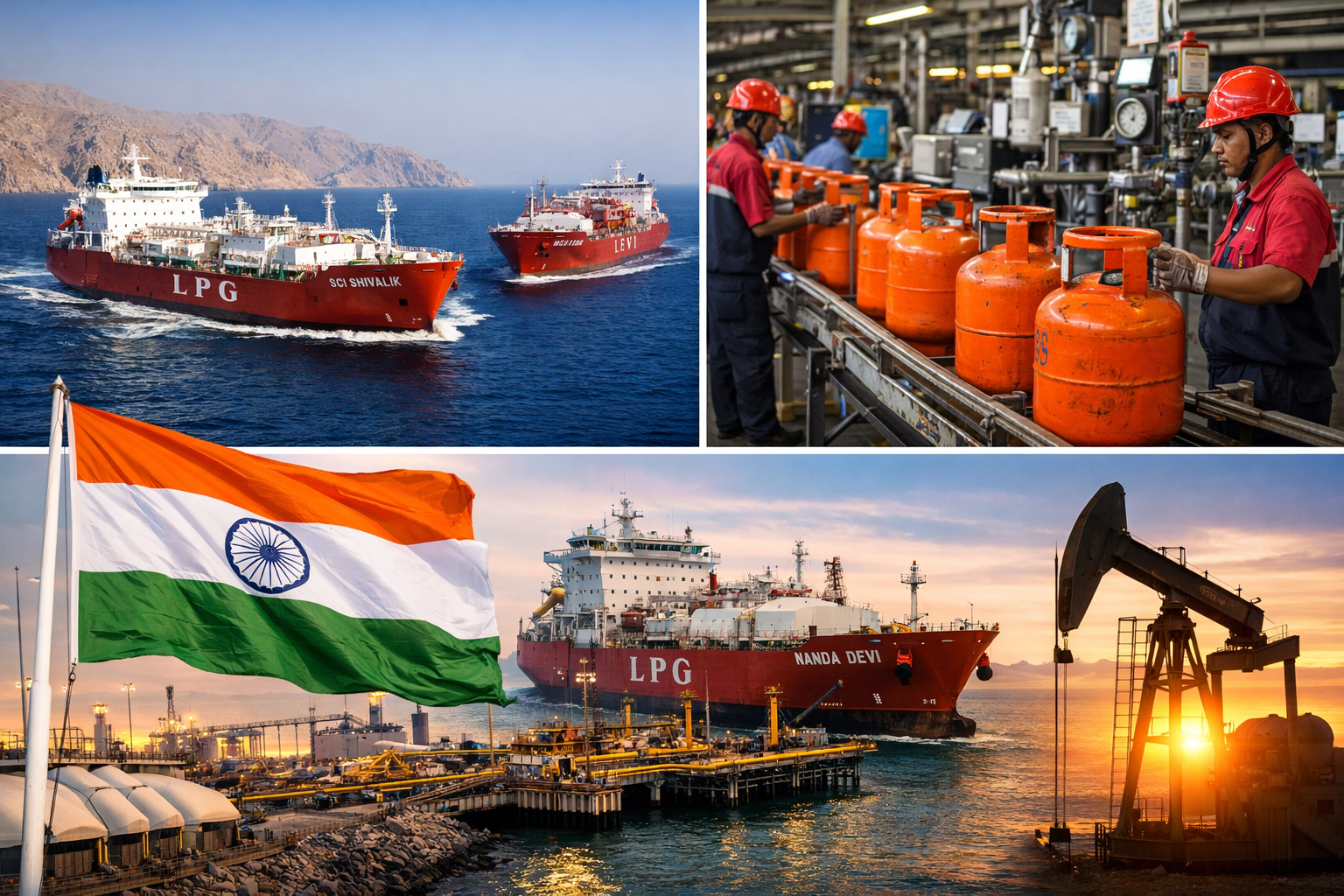
Amid the disruption, developments in maritime logistics have provided some relief. Two LPG carriers—Shivalik and Nanda Devi—owned by the Shipping Corporation of India have safely crossed the Strait of Hormuz and are currently en route to India.
Speaking at an inter-ministerial briefing, Rajesh Kumar Sinha said the vessels crossed the Strait early on March 14 and are headed to Indian ports. Each ship is carrying about 46,000 metric tonnes of LPG, bringing the total shipment to around 92,712 metric tonnes.
Shivalik is expected to arrive at Mundra Port by March 16, while Nanda Devi is scheduled to reach Kandla Port on March 17.
Ship tracking platforms have been regularly updating the positions of the vessels, which have kept their Automatic Identification Systems (AIS) signals active during transit. Since the outbreak of conflict in West Asia, some vessels crossing the Strait have switched off AIS signals during night-time “dark transit” to avoid detection and potential attacks. Nanda Devi, however, reportedly crossed the Strait during the day.
The safe passage of the ships comes shortly after Prime Minister Narendra Modi held discussions with Iranian President Masoud Pezeshkian, during which the issue of uninterrupted maritime transit for oil and gas shipments was raised.
Government officials also confirmed that 22 Indian-flagged vessels remain on standby near the western side of the Strait of Hormuz with 611 seafarers on board. These include six LPG carriers, a natural gas tanker, four crude oil tankers and a chemical tanker, along with container ships, bulk carriers and other vessels awaiting movement clearance.
India operates around a dozen LPG carriers under its national flag with a combined cargo capacity of about 700,000 tonnes. The country imports nearly 20 million tonnes of LPG annually, much of it transported by foreign-flagged ships chartered by oil marketing companies.
Officials said the cargo carried by Shivalik and Nanda Devi will add roughly two days’ worth of LPG imports to India’s supply buffer once discharged.
The government has also highlighted a more than 30 percent increase in domestic LPG production, which currently accounts for about 10 percent of the country’s daily LPG consumption.
To strengthen long-term supply resilience, India has diversified its import sources. In November 2025, oil companies signed a one-year agreement to import 2.2 million tonnes of LPG from the U.S. Gulf Coast in 2026, representing about 10 percent of India’s annual imports.
The United States is the world’s largest LPG exporter with annual shipments of around 60 million tonnes, followed by producers such as the United Arab Emirates, Qatar and Canada. Other potential sources include Nigeria, Malaysia and Singapore, although longer shipping routes—particularly from the United States—can extend voyage times to nearly two months for a round trip.
Meanwhile, the IIA has begun exploring long-term solutions to reduce MSMEs’ reliance on gas-intensive processes. The association has initiated consultations with institutions such as IIT Roorkee, IIT (BHU) Varanasi and IIT (Indian School of Mines) Dhanbad to examine alternative technologies and energy-efficient production systems.
Electric heating technologies, including induction-based furnaces, are among the options being studied, though their adoption will depend on technical feasibility and electricity costs.
Industry bodies say that with fresh LPG shipments arriving, ongoing diplomatic engagement and diversified sourcing strategies, the supply situation is expected to stabilise in the near term, allowing affected industries to gradually restore normal production levels.