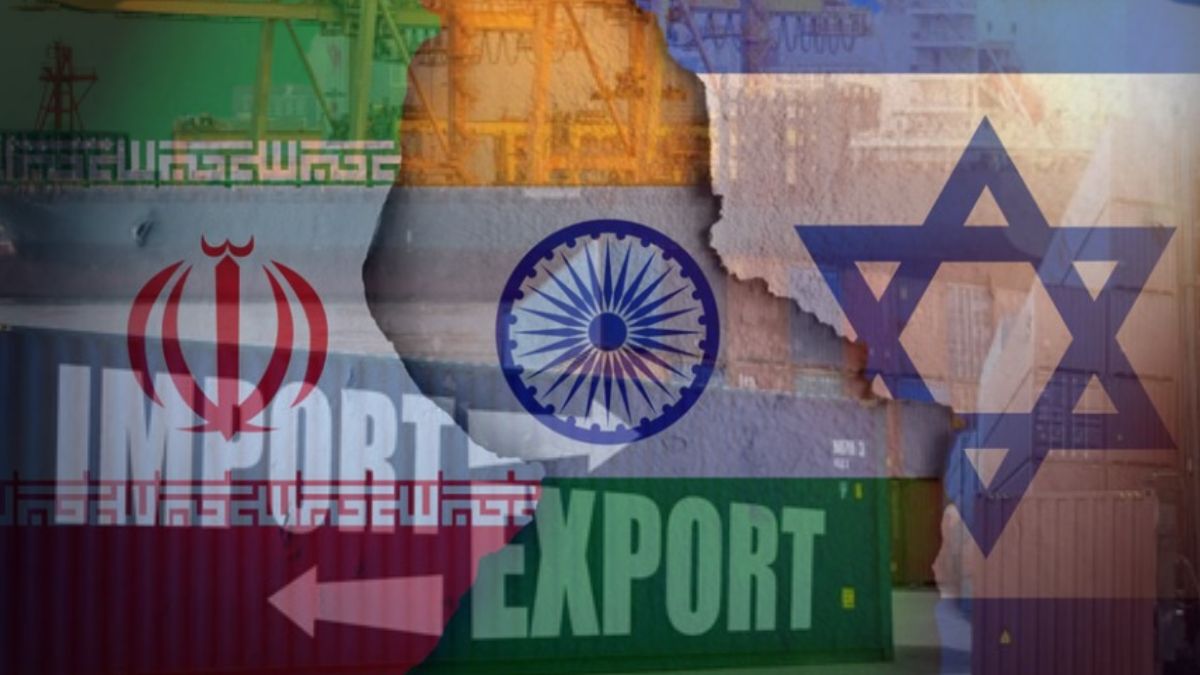
India’s exports are facing a potential 15–20% rise in logistics costs as escalating tensions in the Middle East, particularly between Iran and Israel, continue to disrupt critical trade corridors, according to trade bodies and freight industry experts.
With Iran closing its airspace in response to the geopolitical escalation, Indian carriers are now rerouting flights over longer, costlier paths. This compounds the existing challenge posed by the closure of Pakistan’s airspace, which had already limited direct flight options for Indian exporters to Europe and beyond.

“We are watching the situation. There could be a temporary disruption of some exports, but it is too early to say,” a senior government official said.
Air Freight Takes a Hit
The closure of Iranian, Iraqi, Jordanian, and Israeli airspace has impacted nearly 1,800 Europe-bound flights, with around 650 cancellations, according to flight-tracking data. Indian exporters relying on air freight have been particularly affected, with freight rates in some corridors quadrupling—rising from ₹35/kg to ₹140/kg in recent weeks.
This is particularly concerning given that air freight is typically 7–8 times more expensive than sea freight, making rerouting an expensive option for time-sensitive shipments like electronics, perishables, and pharmaceutical goods.

Red Sea Crisis and Sea Freight Challenges
Trade through the Red Sea and Suez Canal had shown signs of recovery earlier this year, but the new conflict threatens to undo those gains. Shipping lines are once again rerouting via the Cape of Good Hope, adding 14–20 days to transit times.
According to the Federation of Indian Export Organisations (FIEO), this detour has driven sea freight costs up by as much as 600% on certain routes. In addition, war-risk insurance premiums have increased 2–4 times, reflecting the heightened volatility in key maritime corridors.
“Shipping schedules have become irregular again. The unpredictability is causing exporters to hold back consignments, particularly to Europe,” said Ajay Sahai, Director General of FIEO.
Adding to the pressure, Brent crude prices have spiked over 8%, fueled by fears of supply disruptions. With aviation turbine fuel (ATF) and marine fuel being major cost components, the ripple effect on freight pricing is immediate and significant.
India’s Trade Exposure to Israel and Iran
While India’s trade with Israel and Iran is modest in absolute terms, it holds strategic importance:
- Exports to Israel (FY25): $2.1 billion
- Imports from Israel: $1.6 billion
- Exports to Iran: $1.2 billion
- Imports from Iran: $441.9 million
One likely area of impact is the supply of rough diamonds from Israel. However, India’s strong cutting and polishing industry is expected to maintain downstream supply, including to markets that traditionally depend on Israel.
Despite growing logistical challenges, government officials have downplayed any major threat to food and agricultural exports, noting that such disruptions are typically short-lived.
“There could be a small hit to food exports, but we don’t see a concern there because food-related disruptions are usually resolved at the earliest,” said an official.
Ripple Effects on India’s Global Trade Ambitions
India had recently shown signs of cautious recovery in exports, with goods and services exports aiming to cross $900 billion in FY26. However, nearly 80% of India’s Europe-bound maritime trade, along with substantial volumes destined for the U.S., passes through the Red Sea.
If tensions continue, exporters fear potential order cancellations, delayed payments, and reduced competitiveness due to higher landed costs in international markets.
What Comes Next?
- Policy Response: The government is closely monitoring the situation and may consider buffer support or incentives for rerouting if disruptions escalate.
- Private Sector Moves: Exporters are revisiting shipment strategies, renegotiating insurance premiums, and modeling alternative logistics routes for upcoming quarters.
- Strategic Push: Industry bodies are once again emphasizing the need to strengthen India’s shipping capabilities and reduce dependency on international carriers.
The Israel–Iran conflict is a stark reminder of how quickly geopolitical tensions can destabilize global supply chains. For India, the challenge is not only to absorb the immediate cost shocks but to build long-term resilience across its air and sea logistics ecosystems, insulating exporters from future geopolitical or maritime disruptions.