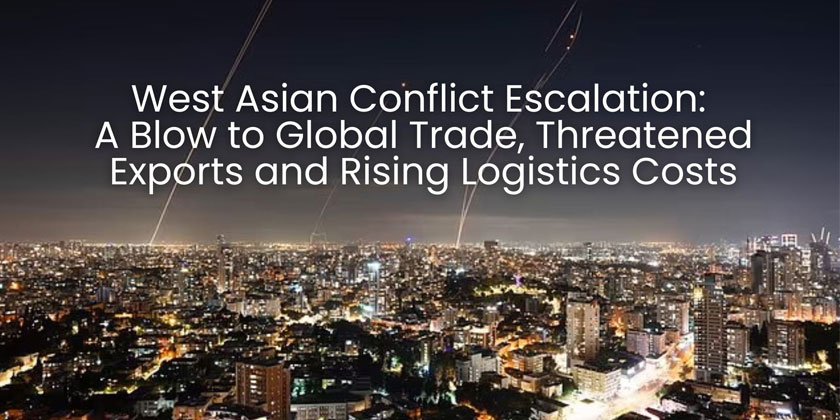
The intensifying conflict in West Asia casts a long shadow over global trade, with ripple effects expected to hit India’s economy, particularly in oil, electronics, and agriculture sectors. Exporters and trade experts have voiced concerns about escalating logistics costs and disruptions to crucial trade routes, compounding the economic pressure already felt due to geopolitical uncertainties in the region.
Exporters fear that the ongoing conflict, especially in countries directly involved in the war, will lead to higher insurance premiums for exports. This, in turn, will have a direct impact on working capital for Indian exporters, many of whom are already grappling with increased operational costs.

According to the Global Trade Research Initiative (GTRI), the conflict is already causing significant disruptions in India’s trade with key regional partners, including Israel, Jordan, and Lebanon. Ajay Srivastava, Founder of GTRI, stated that India’s trade with these nations faced severe setbacks during the first half of 2024. Exports to Israel fell by 63.5%, Jordan saw a 38.5% decline, and Lebanon experienced a 6.8% drop, reflecting the region’s unstable trade environment.
The Federation of Indian Export Organisations (FIEO) also warned that any further escalation could severely disrupt global trade flows. FIEO Director General Ajay Sahai explained that “Iran is a key player in the oil market. Any escalation in the conflict could disrupt oil supplies, leading to higher prices, which would impact global economies, especially those reliant on oil imports.”
The conflict has already pushed oil prices up by USD 4 per barrel, and there are fears that further instability could lead to even more significant price spikes. The Middle East accounts for a large share of global oil production, and disruptions in crucial trade routes like the Strait of Hormuz—through which a substantial portion of the world’s oil passes—would send shockwaves across global supply chains. This could particularly affect shipping costs and cause delays in sectors ranging from electronics to agriculture, further straining international trade.

Ajay Sahai, Director General and CEO, FIEO highlighted the potential for “disruptions [that] could lead to higher shipping costs and delays,” emphasizing that many industries rely on the stability of trade routes through the Middle East. Should conflict escalate, logistical bottlenecks and surging freight prices would undoubtedly make it harder for exporters to meet delivery timelines, particularly those reliant on air and sea routes through the region.
There is also the looming threat of sanctions or trade restrictions from the Western world, should the conflict deepen, especially with Iran. Such measures could have a far-reaching impact on the already fragile global trade dynamics. Exporters noted that as the situation worsens, orders to the affected countries are likely to be placed on hold. Plus, insurance costs will go up, or even worse, exporters may not get any insurance cover in that region.
India’s trade relationships with the West Asian region, particularly with countries like Israel and Iran, are robust and multifaceted. India’s exports to Israel reached USD 639 million in the first four months of the current fiscal year, though the year-on-year decline has been stark. In 2023-24, trade between India and Israel amounted to USD 4.52 billion, with exports including diamonds, petroleum products, and chemicals. The conflict has already taken a toll on these figures, with the GTRI reporting sharp drops in trade due to the war’s escalating impact.
India’s imports from Israel stood at USD 469 million during the same period, with an annual total of USD 2 billion in 2023-24. Beyond oil and diamonds, the bilateral relationship has also expanded into high-tech products, communication systems, and medical equipment, areas where delays could prove costly for businesses.
Iran, another crucial trade partner, saw Indian exports reach USD 538.57 million in April-July 2024. However, the potential for sanctions or further escalation of conflict in the region could complicate trade with Iran, which has traditionally been a key supplier of oil to India.
Trade with Jordan and Lebanon has also been affected. Exports to Jordan totalled USD 228 million during April-July 2024, but the broader regional instability could disrupt this flow further. India’s trade with Lebanon, which saw a modest USD 116 million in exports during the same period, could face even steeper challenges in the coming months.
Despite the turmoil, key West Asian players like Saudi Arabia, the UAE, Kuwait, and Qatar have remained relatively uninvolved in the conflict, offering a modicum of stability in an otherwise turbulent region. These countries are critical to global oil production and trade flows, and their continued neutrality could help mitigate some of the economic fallout.
Nevertheless, the situation remains fluid, and any further escalation could drag these nations into the fray, worsening the impact on trade routes and supply chains.