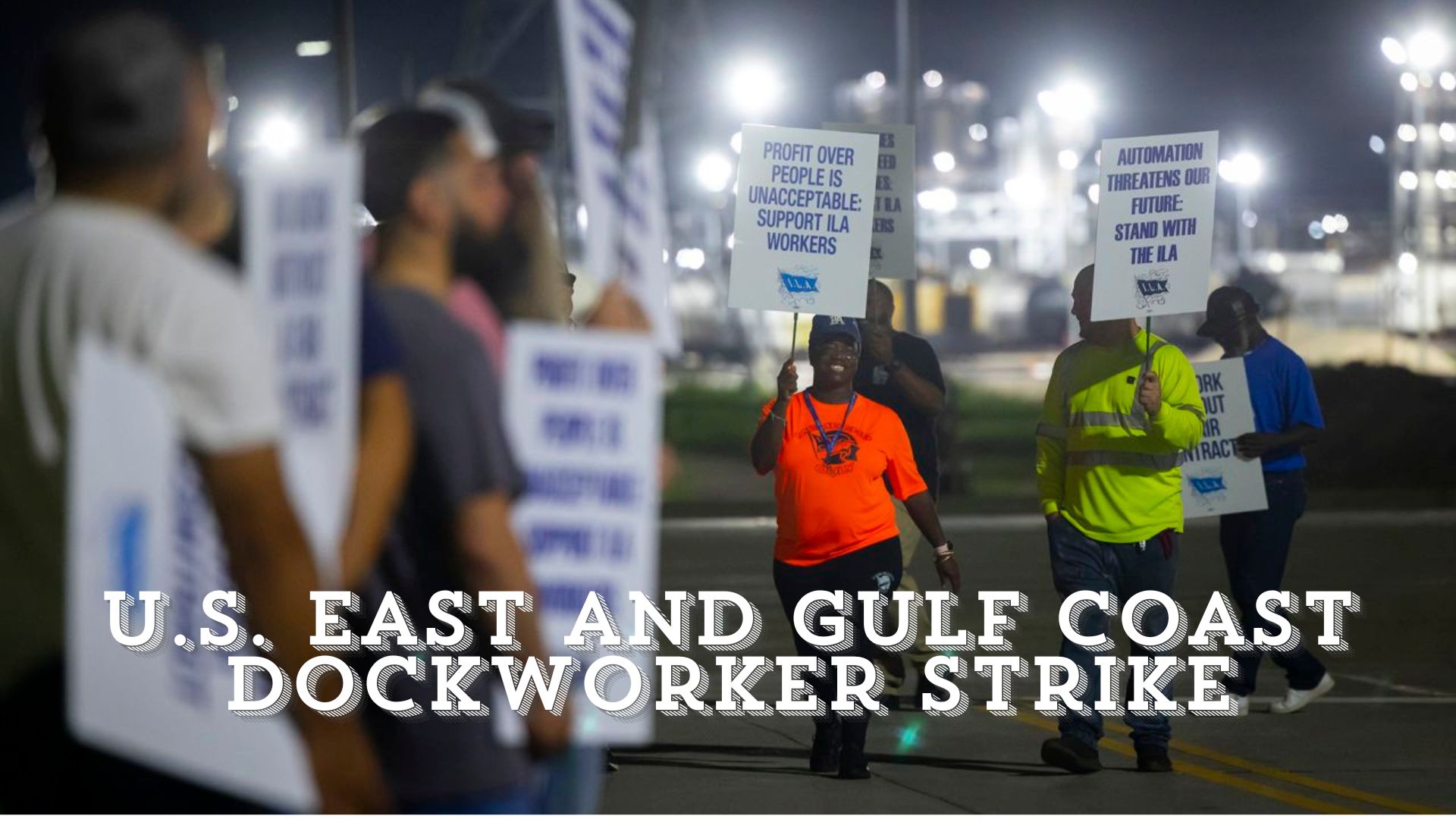
The massive dockworker strike at seaports along the U.S. East and Gulf coasts threatens to disrupt global supply chains and trigger shortages of popular products for American consumers. With nearly half of the nation’s container traffic affected, supply chain managers and logisticians are bracing for impact as the strike is expected to cause significant ripple effects across industries, exacerbating the already fragile global logistics system.
The International Longshoremen’s Association (ILA), which represents approximately 45,000 workers, initiated the strike early Tuesday after negotiations with the United States Maritime Alliance (USMX) employer group broke down just before the September 30 deadline. This is the first such strike in nearly 50 years and spans 14 major ports, from Maine to Texas, which handle billions of dollars worth of cargo daily.

Industry experts are warning of severe consequences if the strike continues for an extended period – the duration amplifies the impact. If this strike goes on for a couple of days, the implications will be short-lived. However, if it drags on, it has cascading impacts throughout the global economy, not just the U.S.
Even a brief disruption could have far-reaching effects, especially in key industries like pharmaceuticals, automotive, and manufacturing. The strike is expected to delay shipments and exacerbate existing supply chain vulnerabilities, including those already impacted by the Panama Canal drought and geopolitical tensions in the Red Sea.
The stakes are particularly high for international trade, given that over 40% of U.S. containerized goods pass through the East and Gulf Coast ports. Peter Sand, Chief Analyst at Xeneta, a freight rate intelligence platform, stressed the significance of the situation, stating, “It’s crunch time with so many things at stake now.”

Sand predicted that the strike could last for at least a week, but even a short disruption could lead to significant delays in global shipping. Vessels queued outside U.S. ports will experience prolonged waiting times, delaying their return to other parts of the world, including Asia and Europe. “We will see disruptions with some ships being late out of Europe and the Mediterranean towards the end of October and early November,” Sand explained, with further delays anticipated for ships departing Asia in late December, which coincides with the pre-Chinese New Year peak shipping period.
For American consumers, the most immediate consequence will likely be shortages of perishable and temperature-sensitive goods like fresh produce. Maersk, a leading global shipping company, has already issued warnings that a one-week shutdown could result in a four- to six-week recovery period, as backlogs and delays compound.
Shippers of perishable goods have begun shifting from ocean to air freight, anticipating delays. According to sources, while air cargo rates have not yet surged dramatically, they are likely to rise if the strike continues into mid-October.
The strike is expected to hit Asian countries particularly hard, with Moody’s Analytics noting that more than 20% of Asian seaborne exports to the U.S. pass through the affected ports. Countries like Cambodia, India, Indonesia, and South Korea, which have a high reliance on U.S. East Coast ports, are likely to face severe disruptions in their trade flows. These nations rely heavily on the smooth functioning of these ports for exporting goods like electronics, crude oil, and textiles to the U.S.
In India’s case, the country’s export-oriented industries, especially in electronics and textiles, are highly vulnerable to the ongoing strike. Moody’s Analytics reported that India’s reliance on these ports means that any extended disruption could lead to critical shortages and production delays.
While the strike has sparked widespread concern, some analysts are not as worried about long-term economic damage. Reports suggested that the U.S. government might step in if the strike threatens to become a protracted issue. The U.S. President has the power under the Taft-Hartley Act, passed in 1947, to suspend a strike for an 80-day “cooling-off period” if national health or safety is at risk. However, President Joe Biden has expressed reluctance to use this legal provision, which raises questions about the strike’s potential duration and long-term impact.
As congestion builds at sea, air freight is becoming an increasingly attractive alternative for shippers. The demand for air cargo has already seen a sharp rise, particularly for routes between Asia and North America. Air freight volumes have grown by double digits in recent months due to ongoing ocean freight issues, and this trend is likely to continue as the strike persists. However, air freight rates have not yet skyrocketed. TAC Index reports show that global air freight rates were up by only 2.3% by the end of September, but experts anticipate more significant increases in the coming weeks, particularly if the strike drags on into late October and November.
Experts have, however, drawn parallels to the 2012 West Coast port strike, which resulted in a surge in charter flights to ease the backlog.