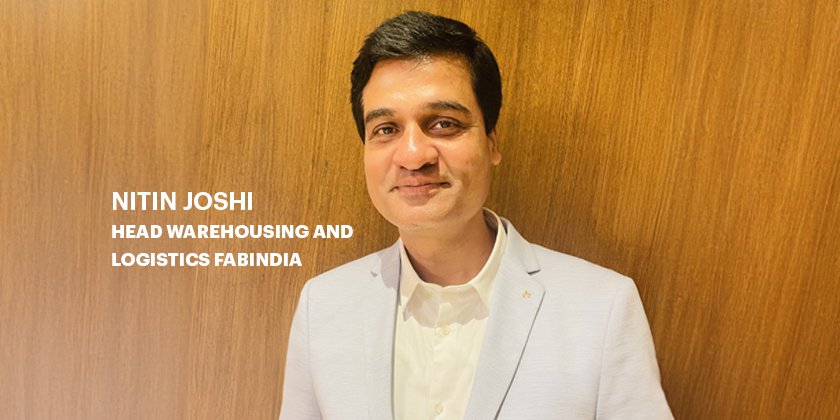
In the ever-evolving landscape of retail supply chains, effective management is crucial for success. For Fabindia, a leading Indian retail brand known for its traditional and sustainable products, this task is in the capable hands of a seasoned professional with extensive experience from renowned companies like Globus and Future Group. In an exclusive interview, we delve into how Nitin Joshi’s journey as their Head of Logistics and Warehousing, has shaped the brand’s approach to managing its supply chain, the strategies implemented to ensure seamless logistics, and the innovative technologies transforming their operations.
How has your extensive experience with companies like Globus and Future Group influenced your approach to managing Fabindia’s supply chain?

Globus and Future group put together is 18 years of extensive experience across these two retail organizations and this has definitely shaped my approach to managing Fabindia’s supply chain. Let’s break down the key points:
1.360-Degree View of Retail Business:
• My tenure at Globus exposed me to various departments, including supply chain, category management, sourcing, and merchandising. This holistic understanding of retail operations influenced my strategic thinking.

• Understanding the entire value chain allowed me to make informed decisions that impact the overall business.
2. Scale-Up at Future Group:
• Transitioning to Future Group provided me with exposure to largescale operations. The 3PL (third-party logistics) business and being part of the supply chain team responsible for 2 million square feet of warehousing space, automation, and tech across diverse verticals expanded my perspective.
• Dealing with such volume and complexity honed my ability to manage warehousing and logistics efficiently.
3. Lifestyle Business Insights:
• Joining Fabindia allowed me to delve into the lifestyle business again, which encompasses fashion, furniture, home furnishings, home décor, personal care, and organic food.
• The focus area was to streamline operations and enhance efficiency.
4. Stabilization and Value Addition:
• My previous experiences equipped me to quickly stabilize Fabindia’s operations. Train the teams to manage the warehousing & logistics functions smoothly.
• Value addition was largely in the form of scaling up operations with better asset and resource utilization.
What strategies do you implement to ensure smooth and efficient last-mile logistics?
In managing Omni-Channel fulfillment (B2B, B2C & D2C), we actively explore diverse transportation modes to optimize delivery efficiency. Containerized Full truck load (FTL) ensures cost-effective movement of large shipments, while Express Cargo (Surface) offers a balance between speed and cost for medium-sized consignments. Air Cargo provides swift delivery for time-sensitive shipments, and various Last mile delivery options cater to Same Day Delivery (SDD) & Next Day Delivery (NDD) requirements, ensuring customer satisfaction.
Collaboration with strategic third-party logistics (3PL) partners amplifies our capabilities. Their expertise, extensive network, and resources enable us to streamline logistics operations, optimize routes, and leverage economies of scale. 3PLs also provide access to specialized equipment, technology, and infrastructure, enabling us to handle complex logistics challenges.
At the core of our logistics operations is a robust Transportation Management System (TMS). This advanced technology empowers us to achieve On-Time In-Full (OTIF) performance consistently. The TMS seamlessly integrates with various systems, providing end-to-end visibility of inventory throughout the supply chain. Real-time tracking capabilities enable proactive monitoring and exception management, allowing us to identify and address potential delays proactively.
With escalating volumes and expanding domestic and international reach, we actively engage with new technology vendors to remain at the forefront of advancements. We continuously evaluate innovative solutions such as autonomous vehicles, drones, and robotics to enhance efficiency, reduce costs, and improve sustainability. By embracing emerging technologies, we aim to transform our logistics operations, drive operational excellence, and deliver exceptional customer experiences.
Can you describe the key challenges currently faced while managing the apparel supply chain? Are there any region-specific challenges?
Managing the apparel supply chain presents unique challenges that vary by region. Globally, the apparel industry faces several key issues. Unpredictable demand patterns, driven by rapid shifts in consumer preferences and fashion trends, make accurate demand forecasting difficult, often leading to overstock or stockouts.
Additionally, long lead times from design to production and distribution impede the industry’s ability to respond swiftly to market changes. The lack of real-time supply chain visibility further complicates efficient decisionmaking, affecting inventory management and order fulfillment. Balancing inventory levels to minimize both excess stock and shortages is a delicate task, as overstocked items tie up capital and stockouts result in lost sales.
Moreover, sustainability is an increasing concern, with consumers demanding ecofriendly products. Implementing sustainable practices, sourcing ethical materials, and reducing environmental impact are critical challenges for the industry.
In India, the apparel industry faces specific challenges alongside the global ones. The sector relies heavily on manual labor, making fair wages, safe working conditions, and compliance with labor laws essential. Infrastructure constraints, particularly in transportation and logistics, pose significant hurdles, with poor road networks and inadequate warehousing facilities impacting supply chain efficiency. T
he supply chain in India is also highly fragmented, involving multiple intermediaries from cotton growers to garment manufacturers, which complicates coordination. Seasonal demand variations due to diverse climate conditions across regions further challenge inventory and production management.
Additionally, navigating regulatory requirements related to labeling, safety standards, and exportimport norms can be cumbersome for apparel businesses.
Addressing these challenges necessitates innovative solutions and agile supply chain management.
This is an abridged version of the Interview Published in the July edition of the Logistics Insider Magazine-India. To read the complete interview, click here.